Topic Library
Every lesson, on four shelves. Each one has something to build, click, or test yourself on.
Foundations
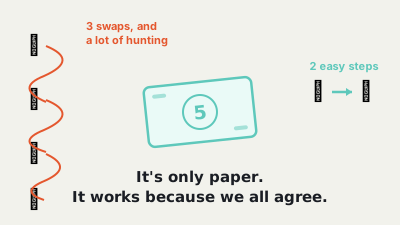
How do we know anything at all? Foundations
What is Science?
How science actually works — observation, hypotheses, and what makes a question testable.
 Foundations
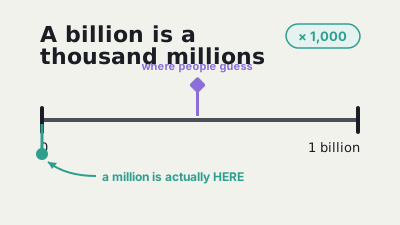
How Big Is a Billion, Really?
Everyone knows a billion is bigger than a million. Almost nobody feels HOW much bigger. It's a thousand times — which means a million is practically sitting on zero. Here's how to make that gap something you can feel.
The Physical World
How do matter, energy, and space behave?Chemistry
 Chemistry
Atoms: The Building Blocks
What atoms are made of, how to read an element, and the difference between atomic number and mass number.
 Chemistry
The Periodic Table
How the periodic table is organised — periods, groups, metals and non-metals — and how to read a single cell.
 Chemistry
Molecules & Bonding
How atoms join into molecules — covalent vs. ionic bonding — and why a water molecule bends.
 Chemistry
States of Matter
Solids, liquids and gases at the particle level — and what really happens during a phase change.
Physics
 Physics
Gravity & Orbits
What gravity is, why the Moon doesn't fall down, mass vs. weight, and the speed you'd need to escape a planet's pull.
 Physics
How Tides Work
Why the sea creeps up and slides back twice a day: the Moon's stretching pull, the two ocean bulges, and how the Sun makes spring and neap tides.
 Physics
Energy: Making Things Happen
What energy is, the two big kinds — moving and stored — and the golden rule: energy never disappears, it only changes costume.
 Physics
Light & the Universal Speed Limit
What light is, how mind-bendingly fast it goes, why nothing can ever go faster — and why looking at the stars means looking back in time.
 Physics
Black Holes: Where Gravity Wins
Put your three keys together — gravity, energy, and light — and open the strangest door in the universe: the place where not even light can pay the exit bill.
Earth & Space
 Earth & Space
How Stars Are Made (and How They Die)
How a cloud of gas becomes a star, why some stars end as white dwarfs and others as black holes, and what mass has to do with it.
 Earth & Space
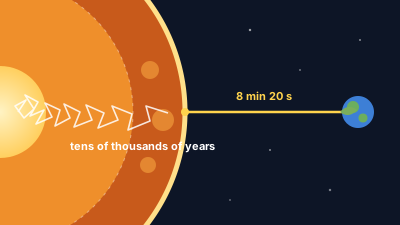
The Longest Journey: How Sunlight Reaches You
Sunlight crosses space in just 8 minutes — but that's the easy sprint at the end. First, the energy spends tens of thousands of years fighting its way out of the Sun. Follow one packet of energy from the core to the food on your plate.
 Earth & Space
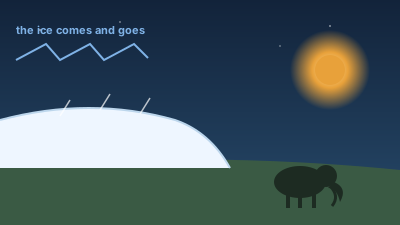
Why Does the Ice Come and Go?
A surprise: we live in an ice age right now. What people call 'the Ice Age' — mammoths, ice over Canada — was the last cold pulse, and we're in a warm gap. Here's what makes the ice come and go.
 Earth & Space
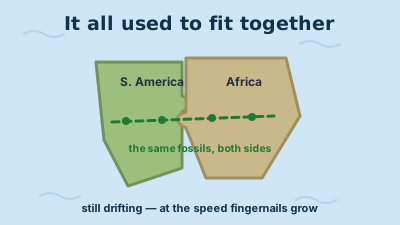
When Earth Had One Giant Continent
A world map looks permanent — but it's one frame of a very slow movie. The continents are moving right now, about as fast as your fingernails grow, and long ago nearly all of them were joined into a single giant continent. Here's how we know.
The Living World
How does life work? Biology
The Story of Cats
Where cats come from, how they evolved over millions of years, and how they (mostly) domesticated themselves by moving in with farmers.
 Biology
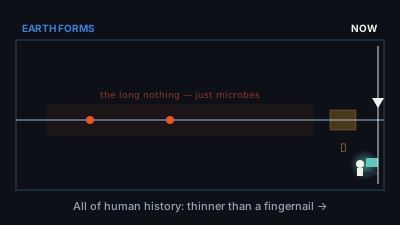
How Long Has Life Been Here?
Life began on Earth almost as soon as it could — then stayed as tiny microbes for billions of years. Almost everything you'd call 'life' is packed into the very end of the story, and people only turned up right at the finish.
 Biology
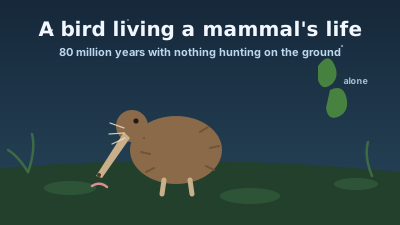
Why Can't a Kiwi Fly?
Your country spent 80 million years alone in the ocean with almost no land mammals — so the birds took over the jobs mammals do everywhere else, and many of them stopped flying. Then people arrived, and everything changed.
 Biology
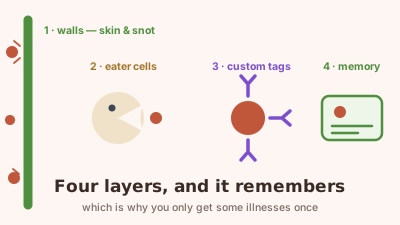
The Army Inside You
Right now you are covered in germs and you feel completely fine. That's not luck — it's a defence system built in layers, like a castle with an army. And the best part is what happens after it wins: your body remembers.
 Biology
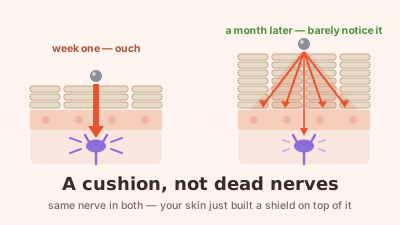
Why Do Guitar Fingers Get Tough?
Your fingertips got sore, and then they got tough. Your body didn't switch the pain off — it felt exactly where you kept pressing and built a cushion of dead skin cells right there, on purpose. And it takes the cushion back down when you stop.