How Long Has Life Been Here?
Life began on Earth almost as soon as it could — then stayed as tiny microbes for billions of years. Almost everything you'd call 'life' is packed into the very end of the story, and people only turned up right at the finish.
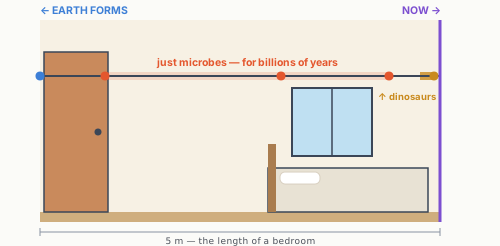
Earth is really, really old — about 4.54 billion years old. That number is so big it stops meaning much, so let’s shrink it down to something you can picture: your bedroom. Imagine a line running the whole length of your room, from one wall to the other. One end is when Earth was born. The other end — right next to you — is now. Everything that has ever happened sits somewhere on that line. Let’s walk along it, and get ready for some surprises.
Surprise one: life showed up almost straight away
You might think life took a long time to get started. It didn’t! As soon as the young Earth had cooled down enough to have oceans, life turned up — tiny living specks called cells, far too small to see. On our bedroom line, that’s way over near the far wall, about 4.19 metres from you.
So the very first life is one of the oldest things in the whole story. Life isn’t a newcomer on Earth — it’s been here almost the entire time.
Surprise two: then, for ages, nothing else happened
Here’s the part almost nobody guesses. After life showed up… not much else happened. For a HUGE stretch of time, every living thing on Earth was still just a single cell. No plants, no animals, no fish, no bugs — just microbes (living things too tiny to see) floating in the sea, making copies of themselves, for well over a billion years.
On our bedroom line, this “long nothing” fills about 71% of the room. You could walk two-thirds of the way across your bedroom and the only news the whole time would be: still just microbes.
Lay it out across your room
First tell it how long your room is — go and pace it out if you like, then set the slider to match. Everything below is redrawn to your room, with the door, the bed and the window all at the same scale, so you can see what those metres really look like.
Then notice how much of your room is the pale band where nothing changed at all. And when the last few events get too small to see, zoom in twice: first onto a 30 cm ruler, then onto a single millimetre.
Your whole room — 4.54 billion years
The far wall is the day Earth formed. The near wall is right now. The door, the bed and the window are all drawn to the same scale as the timeline, so you can see what 5 metres really looks like.
The pale band is the long nothing — about 71% of your room where life stayed as single cells and nothing else happened. The gold band is the whole reign of the dinosaurs: 18 cm, about a hand-span.
- Earth forms — 4.54 billion years ago, 5.00 m from now
- First life — ~3.8 billion years ago, 4.19 m from now
- Complex cells — ~1.8 billion years ago, 1.98 m from now
- First animals — ~575 million years ago, 63.3 cm from now
- Dinosaurs appear — ~230 million years ago, 25.3 cm from now
- Dinosaurs die out — 66 million years ago, 7.3 cm from now
- First humans — ~300,000 years ago, 0.33 mm from now
- Recorded history — ~5,000 years ago, 0.0055 mm from now
Surprise three: going from one cell to many was the hard part
Why did life stay as single cells for so long? Because the next step was really, really hard.
- A single-celled creature is one cell doing everything by itself: eating, moving, and making copies.
- A multicellular creature (that means “made of many cells”) is built from lots of cells that live together and share out the jobs — some become skin, some become tummy, some become brain.
That teamwork sounds easy, but getting cells to stop living alone and start working together — sticking to each other, and each doing its own special job — took billions of years to happen. It was a bigger jump than anything that came afterwards. Once life finally worked out how to be many cells at once, everything you think of as life — animals, plants, you — became possible.
Surprise four: dinosaurs ruled for a hand-span; we are a fingernail
Now look at the crowded corner right next to you, and get ready to have your idea of time turned upside down.
Most people picture dinosaurs as a quick chapter, long ago. It’s the opposite! On our room, the time the dinosaurs ruled is a band about 18 cm wide — a whole hand-span. They were in charge for an incredibly long time, and they died out only a thumb’s length from now.
And us? Our whole species, Homo sapiens (that’s the science name for people), is thinner than a fingernail — only about 0.33 millimetres wide. It’s too thin to even draw on the room line. That’s why the timeline lets you zoom in on the NOW end: all of human life only shows up when you make the last little bit really big.
The last surprise: everything we’ve ever done fits on the edge of a sheet of paper
Here’s the last one, and it’s the biggest.
People are already fingernail-thin on the line. But recorded history — that means everything people have written down: farming, cities, pyramids, kings and queens, every war, every invention, every book, right up to the screen you’re reading this on — all of it happened in the last 5,000 years.
On our room, that’s 0.006 millimetres. That’s about one-twentieth of the thickness of a sheet of paper — take one thin sheet, imagine splitting it into twenty layers, and we’re just one of those layers.
Everything people have ever written down or built fits in a layer too thin to see. Earth got along just fine without us for almost its whole life. We only turned up right at the very end.
Key words
Deep-time vocabulary
Card 1 / 5Front
Check yourself
Deep time — quick check
Question 1 of 5How soon after Earth formed did the first life appear?
Earth has been going for 4.54 billion years, and life for almost all of it — but nearly all of that was just microbes. Everything you’d call alive is squished into the very last bit of the line, and everything people have ever done is thinner than a fingernail. Next time someone says something is “ancient history,” you’ll know just how thin that little bit really is.